

Takeaway
Group art projects can help facilitate team building, wellness, and personal and professional identity formation. Collaging is an accessible form of art that can be easily implemented.
Creative arts in medicine | December 11, 2025 | 2 min read
By Chloe Craig, Da Kyung Jung, Grace Kim, Sadhana Pani, Jakob Quanbeck, Jared Zhang, medical students, & Richard Schaefer MD, MPH, Johns Hopkins Medicine
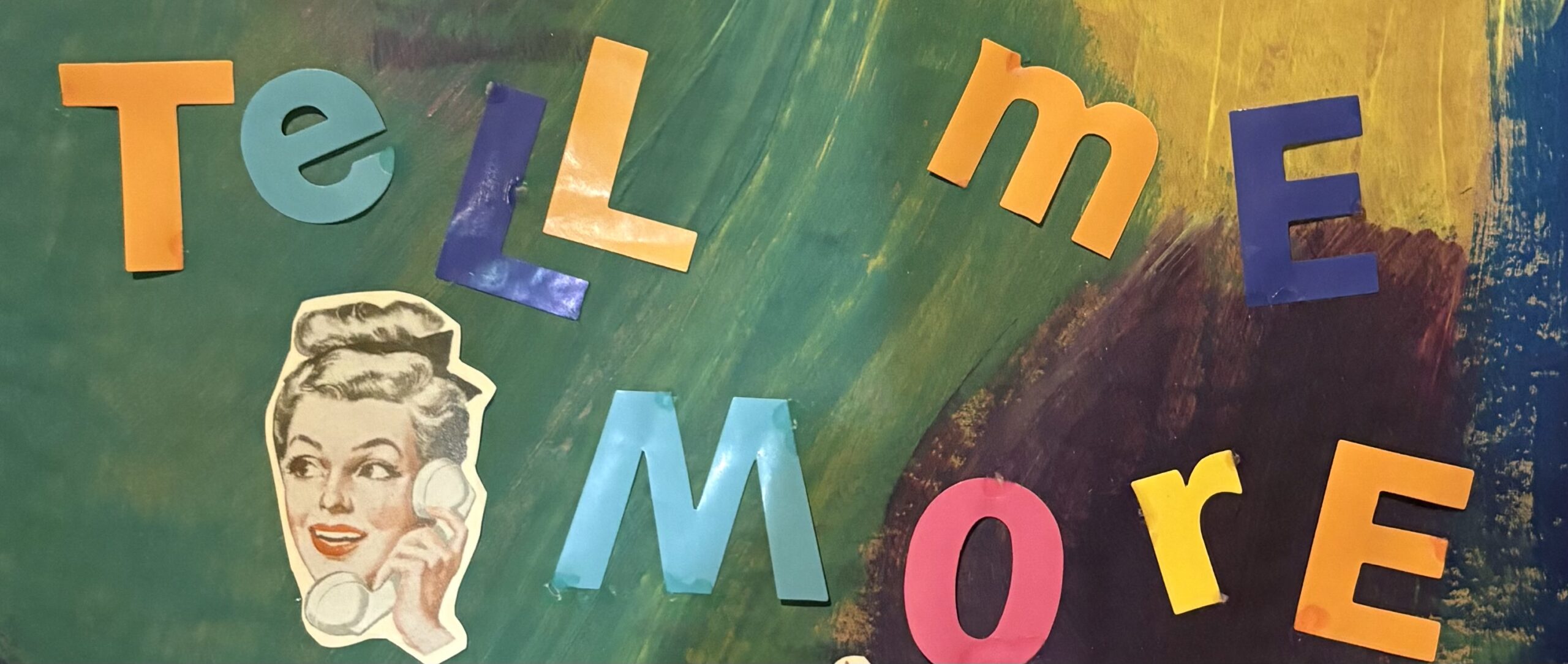
“Tell me more.”
With our small group of students, we were making a collage for a fun team-building activity. In class, the first-year students were learning patient interviewing skills. The phrase “tell me more” was taught and practiced to encourage the patient to share more details about their symptoms in an open-ended manner. Letters spelling that phrase along with a picture of a woman on the telephone were arranged on the collage board.
The students had also recently received their first stethoscopes, and in another section, a cleverly sculpted Play-Doh stethoscope was attached to the ears of a dog picture. Amusing and playful! And it also symbolized their developing professional identity.
In other areas of the artwork there was aspects of their personal identity with magazine cutouts or stickers. In addition to the dog, there was a cat and a fish. License plate stickers representing home states were added. Photos of the group together were added as well.
Additional fun, playful team collages have since been created, including several scrapbook pages that showed the students working and socializing together. And on a larger scale, a collaging exercise was developed and implemented at medical school orientation.
Quotations from participants
The value of collaging together was represented in quotations by students, including this one about their identities and shared humanity:
“We all know we’re human, and have identities beyond medicine, but if your professional identity is all you see every day, sometimes you forget your personal identity. Collaging is a fun and relaxed way to remind each other of that.”
And this one is about the idea that art, in this case group collaging, can be a way to reflect on ideas that may be difficult to articulate:
“Collaging isn’t about being good at art; it’s about reflecting on connections and identities I hadn’t yet put into words.
Green et al. writes that having medical students “create stuff” as part of their education can build resilience, represented in this quotation:
“It’s a gift to be able to step back from lectures and flashcards, and to let our creativity take up space. It can be meditative and inspiring.”
In conclusion, group art projects can help with team building, wellness, and personal and professional identity formation. Collaging may be particularly useful as it doesn’t require advanced artistic skills and is easy for anyone to participate. Clinical teams may benefit from such group art projects as well.

This piece expresses the views solely of the author. It does not necessarily represent the views of any organization, including Johns Hopkins Medicine.