

Takeaway
Adopt a growth mindset—treat setbacks and mistakes as data for learning. Ask “What can we learn?” rather than “Who failed?” to help build psychological safety within your healthcare team.
Lifelong learning in clinical excellence | January 27, 2026 | 3 min read
By Brooklynn Weber, BS, medical student, Evan Gundling, BS, medical student, Quinnipiac University, Erin Barry, PhD, Uniformed Services University, Elizabeth Koltz, EdM, Hackensack Meridian School of Medicine, & Rahul Anand, MD, MBA, MSCI, Quinnipiac University
Prioritizing a growth mindset
In medical school, after hours of watching lectures, taking notes, and reviewing, I sat down to work through practice questions. At first, things felt manageable. Then, the mistakes started piling up. When I saw my score, 50%, a familiar story took over: I’m not smart enough. I’m not cut out for this.
Then I paused and asked a different question: Why am I getting these wrong? Some questions I rushed, some I misread; others revealed gaps in my understanding.
The score itself was disappointing, but the real problem was the meaning I gave it. When I started seeing it as feedback, not a verdict, it became useful. Nothing about my ability had changed. Only the story I told myself did.
Why mindset matters in healthcare
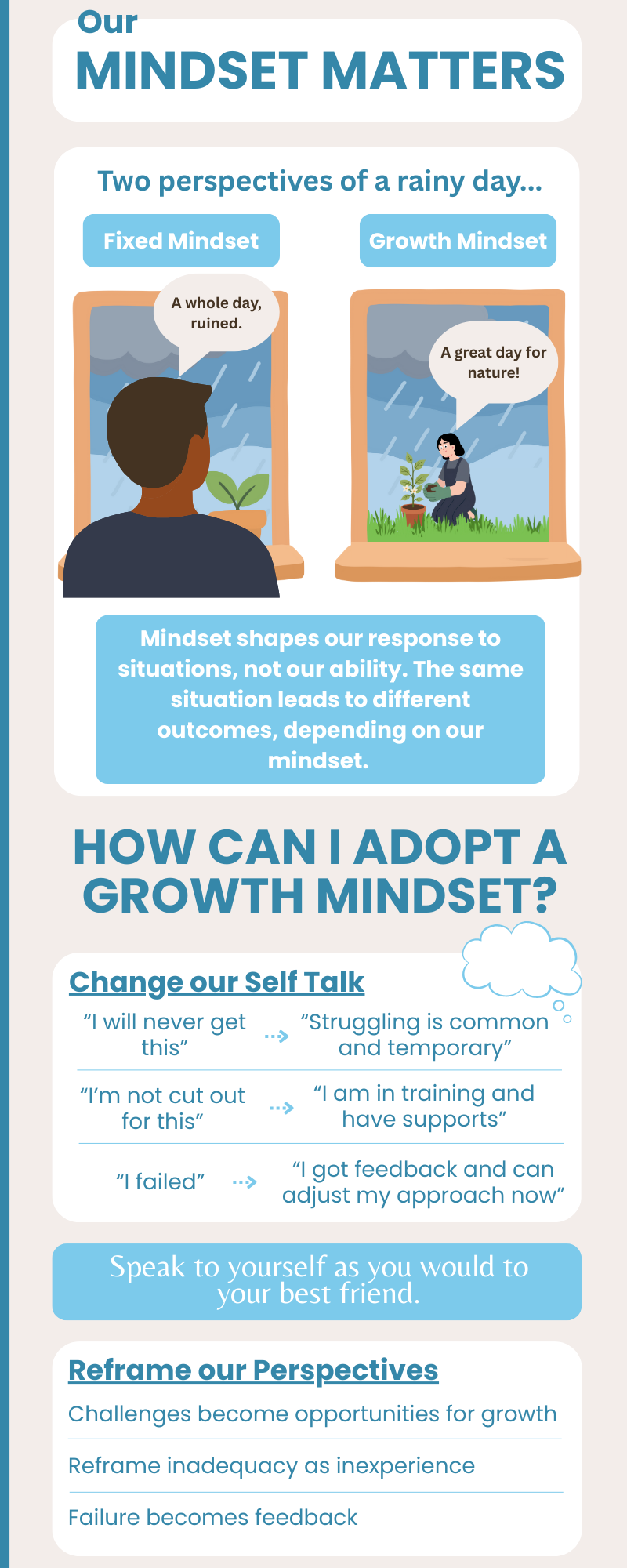
In “Mindset: The New Psychology of Success,” Carol Dweck describes two ways we tend to interpret challenges. A fixed mindset treats ability as static: mistakes mean failure, “I’m not cut out for this.” A growth mindset treats mistakes as feedback we can use to learn, adapt, and improve.
In healthcare, mindset shows up everywhere: how we respond to complications, how we give and receive feedback, and how safe patients and colleagues feel asking for help. After negative feedback, a fixed mindset thinks, I’m bad at this, leading to discouragement and repeated mistakes. A growth mindset thinks, I can improve. I can ask for help. Shifting from judgment to learning creates space for growth and leads to safer, higher-quality patient care.
Importantly, the goal isn’t to live permanently in a growth mindset. As Dweck notes, we all move between mindsets depending on stress, context, and stakes. What matters is awareness: catching ourselves when a fixed mindset is limiting us and choosing to reframe.
From self-talk to patient care
What we say to ourselves shapes how we show up for others. Negative self-talk doesn’t stay internal. It leaks into our tone, body language, and team dynamics. Patients feel it. Learners feel it. Colleagues feel it.
There is a pivot point, though: pause and reflect. When something goes wrong, name the emotion, then ask a different question. Not “Who failed?” but “What can we learn?”
Shifting from judgment to curiosity reduces conflict, strengthens teamwork, and opens the door to meaningful learning and growth.
Practical ways to apply this:
1. Change your self-talk.
Replace “I’m not good at this” with “I’m not there yet.”
2. Reframe mistakes.
Try, “That didn’t go as planned. What did it teach me/us?”
3. Model vulnerability.
Saying “I’m still figuring this out” builds psychological safety.
4. Celebrate small wins.
Growth happens in increments, not overnight.
A growth mindset can help us nurture our inner coach, improve team dynamics, and show up more fully for the patients who trust us with their care. Each of us can prioritize a growth mindset starting right now.
Learn more:
1. “Learning to Lead Podcast.” S3E3: “From Fixed to Growth: Reimagining Mindset in Leadership,” with Erin Barry PhD and Elizabeth Koltz, EdM.
2. Check out this short video: “Reimaging out mindsets” on LinkedIn and below.
This piece expresses the views solely of the authors. It does not represent the views of any organization, including Johns Hopkins Medicine, the Uniformed Services University, or the Department of War.